

A replacement manual safety bearing should match the bearing it replaces. Keep the work area clean while handling and mounting it. These checks provide a sound starting point before installation.
Matching the bearing is only part of the job. Shaft dimensions, mounting details and operating arrangements matter too. Before fitting a replacement manual safety bearing, confirm these factors to reduce the risk of a mismatch.
This guide explains how to assess a replacement bearing and what to consider during mounting and verification. It covers shaft fit, tightening sequence and checks for suitability. You’ll also learn how a manual safety bearing operates and how to approach selection for your application.
Key Takeaways
- Keep the work area clean during handling and mounting to reduce the risk of contamination.
- Choose a replacement identical to the bearing being replaced, and assess shaft fit before installation.
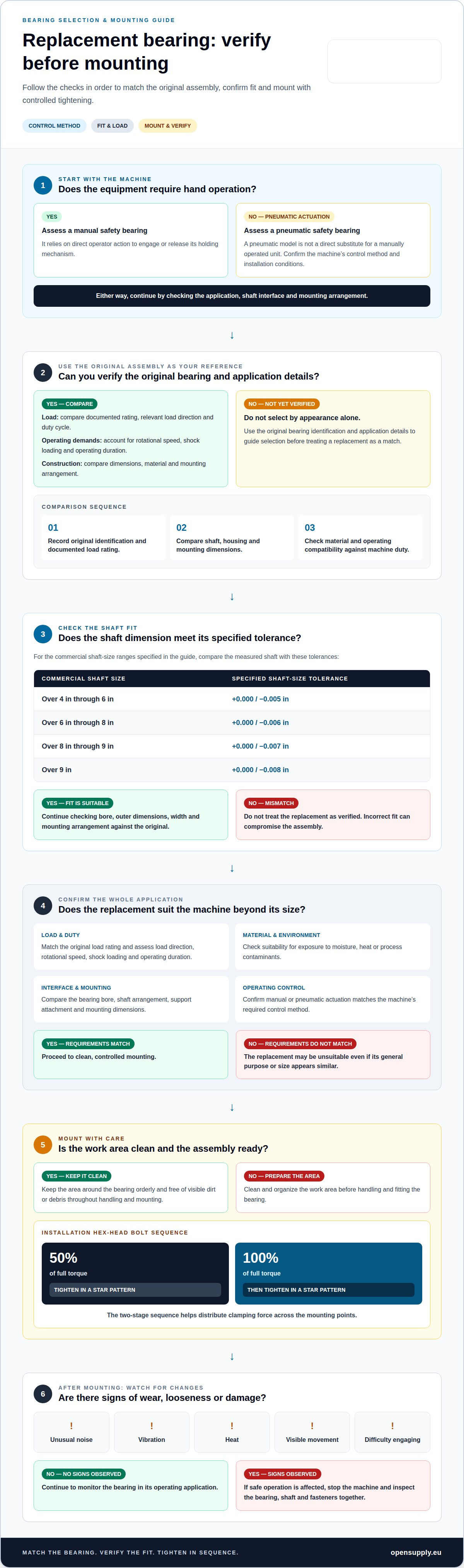
- Follow the specified tightening sequence: tighten to 50% of full torque, then 100%, using a star pattern both times.
- Understand how the bearing’s locking arrangement works to assess whether it suits the application.
Bearing-mounting safety
Safe mounting depends on a clean work area, correct shaft fit and controlled tightening. Treat the bearing, shaft and mounting hardware as one assembly.
Bearing Types and Selection
A manual safety bearing uses operator action, while a pneumatic safety bearing uses pneumatic actuation. Choose between them by assessing the load, shaft dimensions, operating conditions and required control method. For a commercial shaft over 4 inches and up to 6 inches, the specified shaft-size tolerance is +0.000 and -0.005 inches. A suitable fit supports correct assembly.
Manual safety bearings can support shafts or rolls in processing equipment. When replacing one, use the original bearing identification and application details to guide your selection.
Manual Bearing Operation
A manual safety bearing relies on direct operator action to engage or release its holding mechanism. During mounting, keep the work area clean to limit contamination. Tighten installation hex-head bolts to 50% of full torque, then to 100% of full torque, using a star pattern both times. This sequence helps distribute clamping force across the mounting points.
Manual and Powered Alternatives
Manual bearings are operated by hand, while pneumatic alternatives use pneumatic actuation. The required control method and operating conditions guide the choice. Applicable safety requirements depend on the host machine and how it is used. There is no single cost figure: dimensions, load requirements and configuration affect the price.
Risks and Failure Signs
Incorrect fit or uneven tightening can compromise the assembly. Watch for unusual noise, vibration, heat, visible movement or difficulty engaging the mechanism. These signs may indicate wear, looseness or damage. If safe operation is affected, stop the machine and inspect the bearing, shaft and fasteners together. The replacement must match the original and suit the application’s load and operating conditions.
Keep the work area clean throughout the handling and mounting process. Before beginning, make sure the space around the roller bearing is orderly and free of visible dirt or debris, and maintain that condition while the bearing is being handled. A clean work area is part of careful bearing mounting; give it attention before assembly and continue to keep the area clean until mounting is complete.
Verifying a replacement bearing
A replacement bearing should match the one it replaces. Compare its load capacity, dimensions and material with the original assembly before fitting it.
Comparing Load Ratings
Load ratings describe a bearing’s capacity under specified operating conditions. Matching the original rating helps ensure the replacement suits the existing load and duty cycle. Compare the stated rating with the original bearing’s documentation, including whether it covers the relevant load direction.
Assess the full operating case, not just the load at rest. Rotational speed, shock loading and operating duration affect bearing demands. For example, a shaft exposed to intermittent impact needs a replacement suited to those conditions, not merely one with similar external dimensions.
Checking Sizes and Materials
Dimensional verification checks whether the replacement fits the shaft and housing. For commercial shafts over 6 inches and up to 8 inches, the specified shaft-size tolerance is +0.000 and -0.006 inches. For shafts over 8 inches and up to 9 inches, it is +0.000 and -0.007 inches. For shafts over 9 inches, it is +0.000 and -0.008 inches.
Compare the bearing’s bore, outer dimensions, width and mounting arrangement with the original. Check that its material suits the operating environment, including exposure to moisture, heat or process contaminants. Matching only the size can leave a critical mismatch.
Use a practical comparison sequence:
- Record the original bearing identification and documented load rating.
- Compare shaft, housing and mounting dimensions with the replacement.
- Check material and operating compatibility against the machine’s duty.
For application-specific component choices, review bearing selection support alongside the original assembly details.
What types of manual safety bearings are available?
Manual and pneumatic safety bearings differ in how they operate: a manual safety bearing is operated by hand, while a pneumatic safety bearing uses pneumatic actuation. This distinction identifies the control method, not the exact size or capacity. Match the bearing configuration to the machine’s shaft support and required operation.
Start selection with the equipment, not a broad type label. Check how the bearing interfaces with the shaft and supporting structure. Then compare the application’s load and operating conditions with the unit’s documented suitability. A manual safety bearing for one assembly may not fit another, even when both machines perform similar processing tasks.
- Actuation: Determine whether the machine requires manual or pneumatic operation.
- Shaft interface: Compare the bearing bore and shaft arrangement.
- Mounting: Review how the bearing attaches to its support.
- Application: Consider the operating demands and required function.
For example, a replacement in an existing roll-handling machine should match its current shaft and mounting arrangement. A different interface can make a bearing unsuitable, even if its general purpose appears similar. Keep the equipment identification and component details together when evaluating options.
Don’t select a unit by appearance alone. Confirm its operating category and physical arrangement against the machine requirements. A pneumatic model is not a direct substitute for a manually operated unit just because both are safety bearings. Choose the type that matches the equipment’s control method and installation conditions.
How does a manual safety bearing work?
A manual safety bearing supports a shaft and allows an operator to control its engagement or release. How it operates depends on the bearing’s design and the machine’s arrangement, so follow the instructions for the specific unit.
In a typical application, the bearing sits at a shaft support point. Its housing locates the bearing, which accommodates the rotating shaft. A hand-operated mechanism changes the bearing’s state, giving the operator direct control rather than relying on pneumatic actuation.
The difference matters during operation and service. A manual unit requires an operator to act at the machine; a pneumatic safety bearing uses air pressure for actuation. Neither method alone determines suitability. The shaft interface, load, machine layout and required operating sequence all affect selection.
Think through the operation as a sequence:
- Identify the shaft and bearing support arrangement in the machine.
- Use the specified manual control to engage or release the mechanism.
- Confirm the bearing’s position and operation before returning the assembly to service.
The control and engagement procedure varies by bearing design. Don’t assume that turning a handle, lever or fastener has the same effect on every unit. Use the identification and instructions for the installed bearing, and keep its mechanism aligned with the intended position.
Changes in shaft movement, noise or vibration during use can signal an issue with the bearing or surrounding assembly. Inspect the bearing, mounting and shaft interface together. A manual control cannot correct a poor fit or damaged component; it operates only the bearing’s designed mechanism.
For a replacement, match the existing bearing and its operating arrangement before installation. If you’re selecting a unit for an application, review manual safety bearing options against the shaft and machine requirements.
The work area should be kept clean when handling or mounting a roller bearing. Keep this in mind during any bearing work involving handling or mounting, alongside the unit-specific instructions already noted. Cleanliness is a practical part of the task, while the bearing’s manual mechanism remains governed by its design and the manufacturer’s guidance.
Opensupply: Air shaft
Opensupply BV supplies air shafts for processing applications involving roll handling. If your equipment also needs a shaft component, consider the air shaft alongside the bearing and mounting arrangement. These components serve different functions, so assess each against the machine’s requirements.
Opensupply BV also supplies rigid couplings KTS / KTE / KTA divided two-piece, rotary couplings and roller pressure indicator complete sets. These products may be relevant when reviewing connected components in a processing line, but they don’t replace bearing selection or verification. Keep the shaft, coupling and bearing specifications distinct during equipment planning.
For advice on components for your application, contact Opensupply BV.
Plan the Next Bearing Decision
Use the next replacement decision to improve how component information is recorded across the machine. Clear records make it easier to identify the installed unit, compare future alternatives and keep selection decisions consistent as equipment requirements change.
For a manual safety bearing, retain the relevant identification and application details with the equipment documentation. This gives maintenance and purchasing teams a shared reference, rather than leaving them to rely on appearance or memory when a component needs attention.
If bearing selection affects connected equipment, consider the full assembly before finalizing the specification. A focused discussion can help align the component choice with the machine’s operating needs and surrounding parts.
Contact Opensupply for bearing support to discuss your application and component requirements. A clear next step can make future selection work more straightforward.
Frequently Asked Questions
What does "manual safety bearing" mean?
A manual safety bearing is an industrial shaft-support bearing with a safety mechanism operated by hand rather than by pneumatic actuation. “Manual” describes how the mechanism is controlled; it doesn’t specify the bearing’s dimensions, load rating or mounting arrangement. The term alone therefore isn’t enough to identify a replacement for a particular shaft assembly.
How do you install and maintain a manual safety bearing?
Follow the instructions for the exact assembly, since dismounting hardware varies by design. Keep the work area clean and inspect fasteners, bearing surfaces and the shaft interface during service. For a dual-nut assembly using the documented procedure, loosen mounting bolts until each sits 3/8 inch from the external nut. After dismounting, reassemble at 20-30 ft-lbs in a star pattern. Refit locknuts with typically 3-4 exposed threads beyond the external-nut face.


