

Wrinkle-free web handling depends on more than a smooth roller. Spreading rollers use a bowed profile, grooves, or an expanding surface to move material outward, release wrinkles, and help maintain cross-machine tension. That tension also matters after slitting, when separate webs need to track and wind cleanly.
Wrinkles, edge contact, and unstable winding can point to a spreading or tension issue, rather than a defect in the material itself. The right spreading rollers and setup depend on the web, the process, and how the sheet travels through the machine.
This guide explains how spreading rollers reduce wrinkles, widen webs, separate slit lanes, and interact with web tension. It compares common roller designs and outlines the material and application factors that shape selection for coating, laminating, slitting, and rewinding.
Key Takeaways
- Match the roller’s spreading mechanism to the wrinkle pattern and the way the web needs to widen or separate after slitting.
- Balance web tension, wrap angle, and traction; excessive tension or poor traction can compromise edges and winding.
- Choose roller design around the substrate and process, including coating, laminating, slitting, or rewinding.
- For roll handling in a processing line, Opensupply BV supplies air shafts alongside its other industrial components.
Removing wrinkles, widening webs, and separating slits
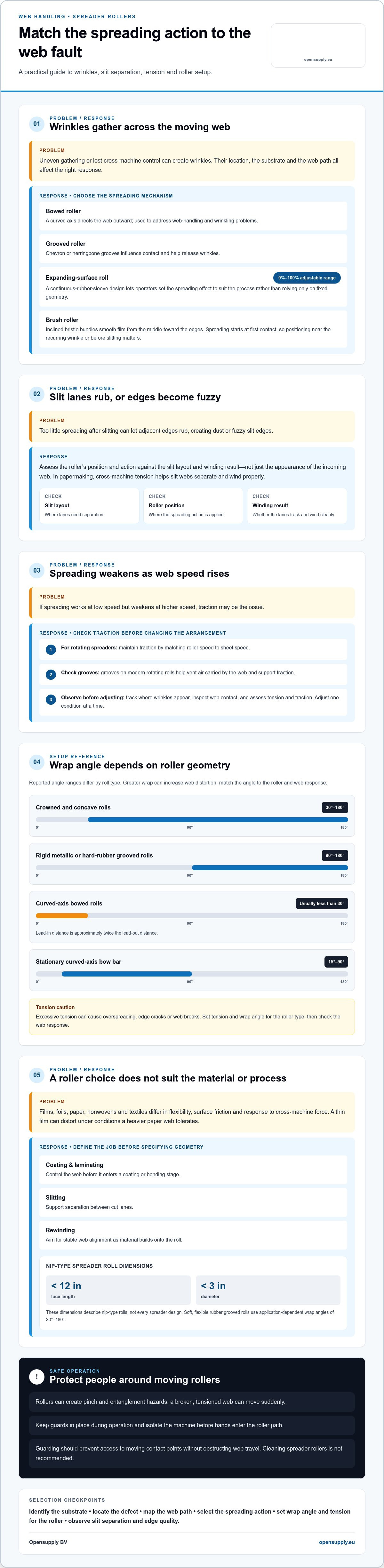
Wrinkles form when a moving web gathers unevenly or loses cross-machine control. Spreading rollers counter this by directing the material outward through their profile or surface. In paper, film, and foil lines, this action can flatten creases before coating, laminating, or winding. The result depends on the wrinkle location, substrate, and web path.
A bowed roller uses a curved axis to move the web outward. Expander rollers widen webs by reducing wrinkles, while chevron or herringbone grooves influence contact and help release them. Continuous-rubber-sleeve expanding-surface rolls provide an adjustable spreading range from 0% to 100%. Operators can set the effect to suit the process instead of relying only on fixed geometry.
Brush rollers use a different mechanism. Inclined bristle bundles smooth film from the middle toward the edges, with spreading starting at first contact. A brush roller can be placed near where wrinkles arise, such as before a slitting station. This targets the problem area instead of applying the same action throughout the web path.
After slitting, sufficient separation helps prevent adjacent edges from rubbing. Too little spreading can create dust or fuzzy slit edges. Assess the roller’s position and action against the slit layout and winding result, not just the incoming web’s appearance.
Start maintenance and troubleshooting by observing the process. Cleaning spreader rollers is not recommended. Track where wrinkles appear, inspect web contact, and assess tension and traction. If spreading weakens at higher speed despite working at lower speed, investigate traction. Excessive tension can cause edge cracks or web breaks, so adjust settings according to the observed fault.
Wrinkle-eliminating rollers are used in the paper, film, and foil industries and are also called spreader rollers or bow rolls. Bowed rollers address web-handling and wrinkling problems across a wide range of materials and web speeds, so selection should reflect the material and the conditions in which the web moves. The name alone does not determine which profile or position will suit a particular line. The wrinkle pattern and where it appears are central to the assessment.
A brush roller starts spreading as soon as the web makes contact. Keep this immediate action in mind when positioning the roller relative to a recurring wrinkle or slitting station, and when assessing whether it addresses the problem at the right point in the web path.
Web tension and cross-machine spreading
Cross-machine tension helps a paper sheet remain controlled across its width. In papermaking, a spreader maintains that tension so slit webs separate and wind properly. The roller’s wrap angle affects spreading force and distortion. Crowned and concave rolls commonly use 30 to 180 degrees of wrap, while greater wrap can increase web distortion.
Roller geometry sets different operating conditions. Rigid metallic or hard-rubber grooved rolls normally use 90 to 180 degrees. Curved-axis bowed rolls usually need less than 30 degrees, with the lead-in distance approximately twice the lead-out distance. A stationary curved-axis bow bar can use 15 to 90 degrees. Match the angle to the roller type and web response.
Traction is another control point. A rotating spreader maintains traction when its speed matches the sheet speed. Grooves on modern rotating rolls help vent air carried by the web and support traction. If spreading works at low speed but weakens at higher speed, investigate traction before changing the roller arrangement. Excessive web tension can cause overspreading, edge cracks, or breaks.
Rollers can create pinch and entanglement hazards, and a broken, tensioned web can move suddenly. Keep guards in place during operation and isolate the machine before hands enter the roller path. Guarding should prevent access to moving contact points without obstructing web travel.
In the United States, roller cost depends on design, face width, covering, and adjustment requirements. Compare those specifications and the intended process rather than relying on a generic price range.
To position a roller, first match it to the web path, then align its axis across the machine. Set the wrap angle and tension for the roller type, and confirm that a rotating roll’s speed matches the sheet speed. Observe slit separation and edge quality during operation, then adjust one condition at a time.
For related web-path components, explore industrial web-handling components.
Materials and applications
Modern spreader designs accommodate films, foils, paper, nonwovens, and textiles. These substrates differ in flexibility, surface friction, and response to cross-machine force. A thin film can distort under conditions that a heavier paper web tolerates. Start selection with the material and the defect to control, such as wrinkles, poor slit separation, or uneven winding.
Process location matters, too. In coating and laminating lines, a roller helps control the web before it enters a coating or bonding stage. In slitting, spreading supports separation between cut lanes. During rewinding, the aim is stable web alignment as material builds onto the roll. The same roller arrangement may not suit all three operations because each has a different web path and handling requirement.
Typical dimensions depend on roller type and the machine layout. Nip-type spreader rolls are normally less than 12 inches in face length and less than 3 inches in diameter. Those dimensions describe nip-type rolls, not every spreader design. For soft, flexible rubber grooved rolls, application-dependent wrap angles range from 30 to 180 degrees.
Use the substrate and process to narrow the specification. Identify the web material, its path, the defect location, and the required spreading action. Then compare the roller’s face length and diameter with the available machine space. For a grooved rubber roll, consider the wrap angle needed for the application. This approach connects the selected geometry to actual web handling.
For example, a paper slitting line needs controlled cross-machine tension so slit lanes separate and wind properly. A film line may instead need a roller arrangement that limits distortion while maintaining alignment. Nonwovens and textiles also need a setup suited to their material response. Evaluating each substrate in its actual process helps distinguish a roller-size issue from a web-path or tension issue.
What types of spreading rollers are available?
Roller designs differ in how they apply force across the web. A bowed roller has a curved axis and may use a fixed or adjustable bow. Its surface can have a rubber covering or steel segments. This design suits lines where the web needs controlled outward movement across the roller face. Compare the bow arrangement with the web path and available mounting position.
Grooved rollers use surface patterns to influence web contact. Common configurations include herringbone, chevron, reverse-taper, and grooved-rubber-cover patterns. Groove direction affects how the web moves across the roller. For example, a herringbone pattern directs contact outward from the center. Choose a pattern based on the required spreading action and web travel direction.
Brush rollers use inclined bristle bundles to move film from the middle toward its edges. Technical brush rollers can also replace conventional deflection rollers, combining redirection with spreading in a suitable setup. Position matters: placing one where the web first needs smoothing can target a local handling problem. Spreading rollers with other surface designs apply force differently.
Expanding-surface designs include slat-type, polymer-band, and continuous-rubber-sleeve rolls. The continuous-sleeve design provides an adjustable spreading range from 0% to 100%. Slat and polymer-band designs spread through their expanding surface as the web wraps around the roll. These options suit lines where spreading needs to be adjusted through surface action rather than a fixed bow.
To narrow the choice, identify the substrate, defect location, web direction, and process stage. Then compare fixed or adjustable geometry, surface pattern, and available space. Spreading rollers should be selected for the actual line condition, not just by design name. If web direction also needs control, explore guiding rollers for web handling.
Opensupply: Air shaft
Opensupply supplies air shafts for roll handling in web-processing lines. An air shaft secures a core so operators can handle wound material during winding or unwinding. It supports roll handling, while spreading rollers manage web width and wrinkle control. Consider an air shaft when the process requires handling a core-mounted roll.
System fit depends on the roll-handling setup and how the shaft connects with surrounding equipment. Opensupply also supplies divided two-piece rigid couplings KTS / KTE / KTA, rotary couplings, and roller pressure indicator complete sets. These components serve other mechanical needs in processing equipment; they do not replace a spreader’s function.
For an air shaft or related roll-handling component, contact Opensupply to discuss your application.
Set the next process improvement in motion
Before changing a line, record where the defect starts and how it changes through the process. Note the web material, slit layout, operating speed, roller position, and current tension settings. This gives your team a practical baseline for evaluating spreading rollers without confusing a tracking issue with a spreading problem.
Use the observed result to define the next adjustment, and record how the defect responds to each setting change. A clear comparison helps narrow down the cause and keeps equipment discussions focused on the operation.
Opensupply supplies components for processing industries, including air shafts, divided two-piece rigid couplings KTS / KTE / KTA, and rotary couplings. For a conversation about your web-handling application, contact Opensupply about spreading rollers. A well-defined process issue is a useful starting point for your next equipment decision.
Frequently Asked Questions
What are spreading rollers and how do they work?
Spreading rollers are web-contact components that generate outward movement to reduce folds or improve lateral tracking. Their action comes from geometry or surface: a bowed axis redirects the web, grooves influence contact, and brush or expanding surfaces spread it in different ways. Diagnose where the wrinkle first appears; a roller placed upstream of that point cannot correct its source.
What industries use spreading rollers?
Spreading rollers are used in converting operations that process paper, film, foil, nonwovens, and textiles. For example, a film converter may need stable web handling before a coating or lamination station, while a paper operation may focus on separation and winding after slitting. The substrate and line stage determine the roller’s role, not the industry label alone.
How do you choose the right spreading roller for a material and application?
Document the defect position, web material, line stage, mounting space, and existing web path. Then compare candidate roller geometry with the required spreading direction and the web’s response during a controlled run. If edges become damaged or tracking worsens, assess tension and traction alongside roller choice. Changing the roller type alone may not address the underlying cause.
How much do spreading rollers cost in the United States?
In the United States, cost depends on the roller’s design, face width, covering, and adjustment requirements. Compare those specifications for the intended process rather than relying on a generic price range.


