

What if the equipment used to move a roll through a facility isn’t the component that controls it on a processing line? That distinction matters when catalogue categories overlap. Roll handling equipment can refer to material movement, roll support, or components that guide and measure a moving web. The right choice depends on the task, not just the product label.
It’s common to need a clearer link between a component and its role in the process. This article explains how roll handling supports material movement and web processing, and how to identify the categories relevant to your operation. It distinguishes handling equipment from line components, then connects air shafts, guiding and spreading rollers, and roller pressure indicators to practical process tasks. You’ll also see what application details to gather, such as the roll’s role in the line and the process requirement the component must address, before comparing products. That context makes product selection more focused and helps separate movement needs from web-control needs.
Key Takeaways
- Start by defining whether the task is moving a roll or managing material within the production process; this distinction narrows the relevant roll handling equipment.
- Trace the material path through the line to identify where support, guidance, spreading or pressure measurement is needed.
- Air shafts, guiding rollers, spreading rollers and roller pressure indicators serve distinct roles; select a category based on the process task.
- Before reviewing products, gather the roll’s role in the line and the specific process requirement the component must address.
What Does Roll Handling Equipment Cover in Industrial Processing?
In industrial processing, roll handling equipment covers the movement of rolls between storage, machines and work areas, their support at a process station, and the handling of material as it moves through production. These are related tasks, but they do not call for the same equipment category. General material-handling equipment includes systems for transporting and positioning loads; process-line components address the roll or web at a particular stage of production.
Roll handling moves or supports the roll; web handling controls or guides material as it passes through a process.
| Task | Equipment category | Where it operates |
|---|---|---|
| Move a roll between work areas | Facility transport equipment | Storage areas, aisles and machine zones |
| Hold or support a roll for processing | Roll-support components, such as air shafts | At a machine or process station |
| Guide or measure material in motion | Web-process components, such as guiding rollers or pressure indicators | Along the process line |
Material movement versus web handling
Facility movement concerns the route a roll takes from storage to a machine or between work areas. The handling method depends on the movement task and facility layout; no single machine category applies to every operation. Web handling begins at the process line. Its components support, guide or measure material while it passes through production. Separating these tasks helps prevent a transport requirement from being confused with a process-control need.
Which industries use roll handling equipment?
Rolls are used in processing and converting contexts such as packaging, tissue and label production. Across these settings, the key distinction remains the same: transporting a roll around a facility differs from supporting or guiding material in a machine. Identify which task is causing the operational requirement first. That gives equipment selection a practical starting point without treating facility transport and process-line components as one system.
How Do Roll Handling Components Support a Processing Line?
Once material reaches the line, component choice depends on what must happen at each station. A shaft category relates to the roll position; rollers relate to the web path; a pressure indicator measures roller pressure. These categories address distinct tasks. They aren't interchangeable parts or, by themselves, a complete processing system.
Air shafts, guiding rollers and spreading rollers
An air shaft is a category to consider where the roll is positioned on a shaft as part of the process. Its exact suitability depends on the machine and application. Guiding rollers relate to directing the web along its route through the line, while spreading rollers are a separate category for spreading material. For each, start with the position in the line and the task required, rather than assuming features or performance from the category name. A dedicated air shaft guide and roller explainers can provide further context.
Mechanical roll movement and line components also address different operational questions. For work involving loading or positioning substrate rolls, the OSHA printing industry guidelines provide relevant safety information. That guidance concerns handling practices, not the function or specification of a particular component.
When roller pressure measurement is relevant
Where the process requires a roller pressure reading, the roller pressure indicator complete set measures roller pressure quickly and accurately. This is a measurement task, distinct from guiding a web or supporting a roll. It can help the operator assess pressure as part of the process, without treating the indicator as a substitute for shafts or rollers. A dedicated roller pressure indicator article covers measurement details.
Choose the component by its job at the process station: position the roll, guide or spread the web, or measure roller pressure. To review these categories together, explore the roll and web handling components in the product catalogue.
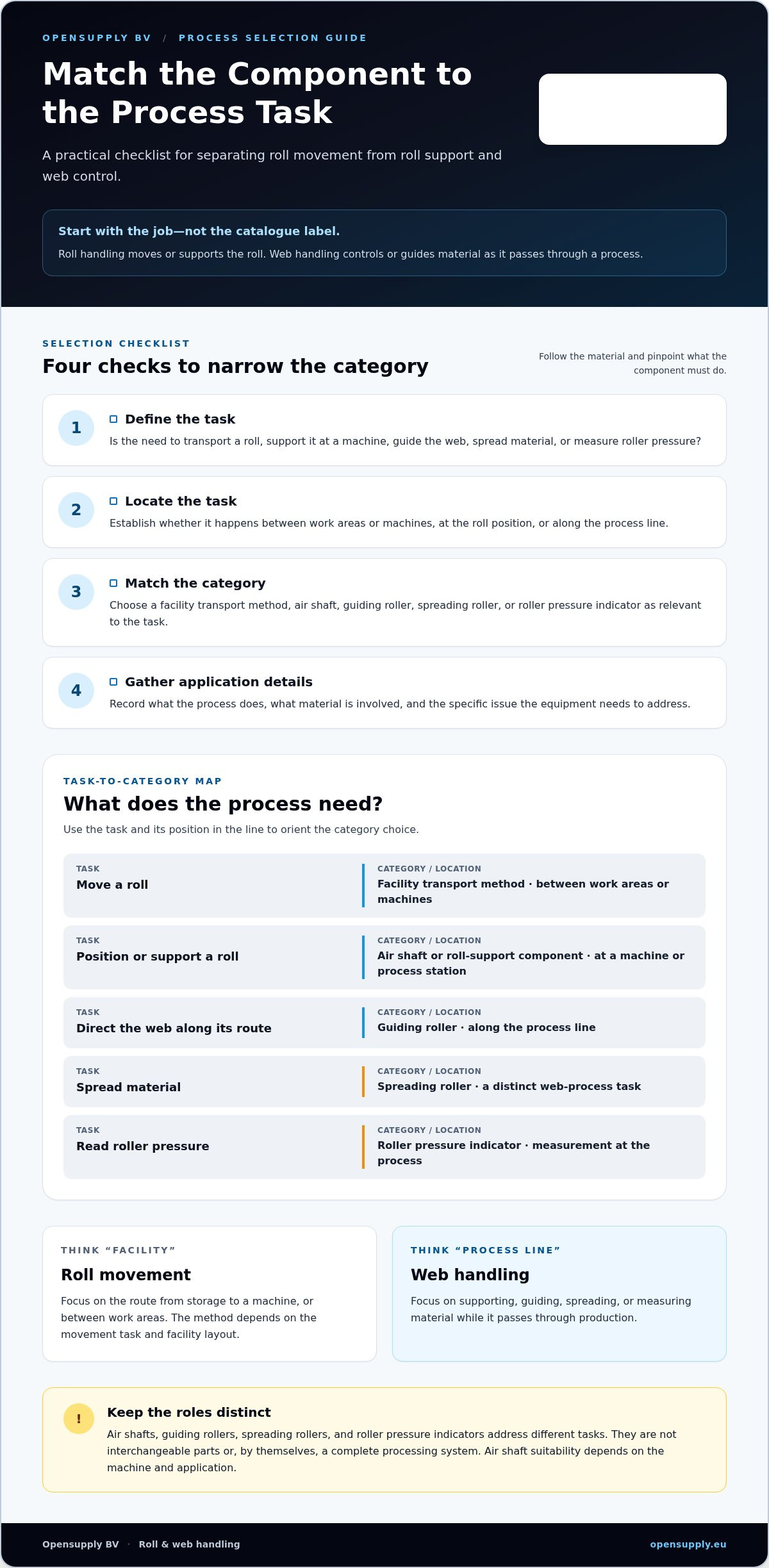
How to Match Roll Handling Equipment to the Process Task
Choose by the job the component must perform, not by a broad catalogue label. Roll handling equipment may relate to moving a roll through the facility or supporting material at a process station. Those needs lead to different categories.
- Define the task. Is the requirement transport, roll support, web guidance, spreading or pressure measurement?
- Identify the material path. Note whether the task occurs between machines, at the roll position or along the process line.
- Select the category. Match the task to a transport method, air shaft, guiding roller, spreading roller or roller pressure indicator, as relevant.
- Gather application details. Record what the process does, what material is involved and what issue the equipment needs to address.
Start with the roll’s task and position
Location helps clarify the distinction. A roll that needs to move between machines presents a facility-transport task. A roll positioned at a machine may call for a support component. If the concern arises as material travels along the line, consider web guidance, spreading or pressure measurement instead. For manual movement or positioning tasks, the NIOSH manual material handling guidelines provide relevant ergonomic guidance.
| Process task | Category to consider | Task location |
|---|---|---|
| Move a roll | Facility transport method | Between work areas or machines |
| Support a roll | Air shaft | At the roll position |
| Guide or spread material | Guiding or spreading roller | Along the process line |
| Measure roller pressure | Roller pressure indicator | At the relevant roller station |
Prepare useful details for technical advice
Bring a concise process description, the material involved and the specific issue to address. Focus on where the issue occurs and what the line needs the component to do. Category explainers for guiding and spreading rollers can help clarify their distinct roles.
Ready to narrow down the relevant category? Explore roll and web handling components.
Explore Opensupply Roll Handling Components and Next Steps
Opensupply BV supplies several categories relevant to roll and web processing. Match the category to the requirement identified in your process, rather than treating the range as a single handling system. An air shaft relates to the roll position; guiding rollers and spreading rollers relate to the material path; the roller pressure indicator complete set measures roller pressure quickly and accurately.
Find the category that matches your application
If your application involves positioning a roll, review the air shaft category. For a web path that needs guidance or spreading, consider the relevant roller category. If the task is checking roller pressure, the indicator set is the relevant option. Opensupply’s online product catalogue provides a way to review these categories. Category-specific information can also help clarify the role of an air shaft or roller pressure indicator.
Before reviewing products, note where the component fits in the process and what task it must address. A concise description of the application helps keep product questions focused on the right category and its relevance to the operation.
Get product advice from Opensupply
Opensupply offers personal technical advice for industrial product questions. The team can help before or after an order with technical advice, delivery-time questions or order status. Include the process task and the product category you’re considering when you get in touch.
For a question about roll handling equipment, email [email protected] or call +31 541 700 260. Explore the online catalogue or request advice on the category that fits your application.
Make the Next Equipment Decision Application-Specific
A useful next step is to connect a component choice to the operating point it serves. Note what the production team needs to change or maintain, where that need occurs, and how the selected component fits the existing process. This gives product review a clear purpose and helps keep the discussion focused on the application rather than broad catalogue labels.
Opensupply BV supplies niche industrial products to processing industries, with personal technical advice available before or after ordering. Bring your process question to the catalogue review, whether you’re assessing a new requirement or clarifying a component choice. The aim is a more direct route from the operating task to relevant roll handling equipment.
Explore Opensupply roll handling products and identify the categories that fit your application. A clear technical question is a practical place to start, and Opensupply’s team can help you consider the relevant product options. Take the next step with confidence.
Frequently Asked Questions
What is roll handling equipment?
Roll handling equipment is a broad term for equipment and components involved in handling rolls in industrial production. Some systems move rolls between storage and machines; process-line components support a roll or web at a machine. The relevant category depends on the task and where it occurs in the process. The term doesn’t mean every supplier’s catalogue includes both facility transport and line components.
Is roll handling equipment the same as web handling equipment?
No. The terms overlap in processing, but they describe different aspects of the operation. Roll handling can include moving or positioning a roll before it reaches a machine. Web handling concerns material as it travels through a process. A line may use related components for both tasks, but the combination depends on the application. Identify whether the need concerns the roll or the moving web.
What information should I gather before selecting roll handling equipment?
Describe the task, the roll or material involved, where the equipment will operate and the process issue to address. For example, explain whether the concern occurs while a roll is being positioned or as material moves through a machine. These details are useful starting points, not a mandatory specification checklist. Opensupply can provide technical advice based on the application you describe.
What is an air shaft used for in roll handling?
An air shaft is a roll-handling component used in processing applications. Its relevance depends on the role it needs to perform at the roll position and how it relates to the machine or process. The term alone doesn’t establish construction, clamping method, capacity or compatibility. For a fuller explanation of the category and its application, consult the dedicated air shaft guide.
What does a roller pressure indicator measure?
The Opensupply roller pressure indicator complete set measures roller pressure quickly and accurately. This makes it relevant when the process question concerns pressure at a roller, rather than roll movement or web guidance. The stated product information doesn’t specify a measurement range or additional performance figures. For more detail about the set and its measurement role, consult the dedicated roller pressure indicator article.


