

Leak control depends on the seal staying aligned as steam passes from a stationary supply into rotating equipment. A steam rotary coupling uses sealing faces to restrict escape at this interface; mechanical-face-seal designs can have leakage rates below 0.05 cm³/hr. Bearings support rotation, while the housing contains the steam.
That sealing principle is central to high-pressure service, but pressure alone does not determine performance. Temperature, rotational speed, seal materials, and condensate behaviour also affect how the assembly operates.
This article explains how steam rotary joints transfer fluid between fixed and rotating parts, how seal and passage designs manage leakage, and which operating conditions matter in applications such as paper drying, manufacturing, and power generation.
Key Takeaways
- Match seal material to steam temperature and operating conditions; graphite-impregnated seals are commonly used above 200°C.
- Choose a one-passage or two-passage arrangement based on whether the process needs one-way flow or both supply and return.
- Assess pressure, temperature, rotational speed, and condensate behavior together when specifying a coupling for high-pressure service.
- Account for application demands: drying drums, textile equipment, manufacturing processes, and power-generation systems place different requirements on fluid transfer.
- Use leakage, unusual noise, and elevated temperature as inspection indicators, and include seal wear and lubrication in regular checks.
Custom seals, connections, materials, coatings, and passage designs
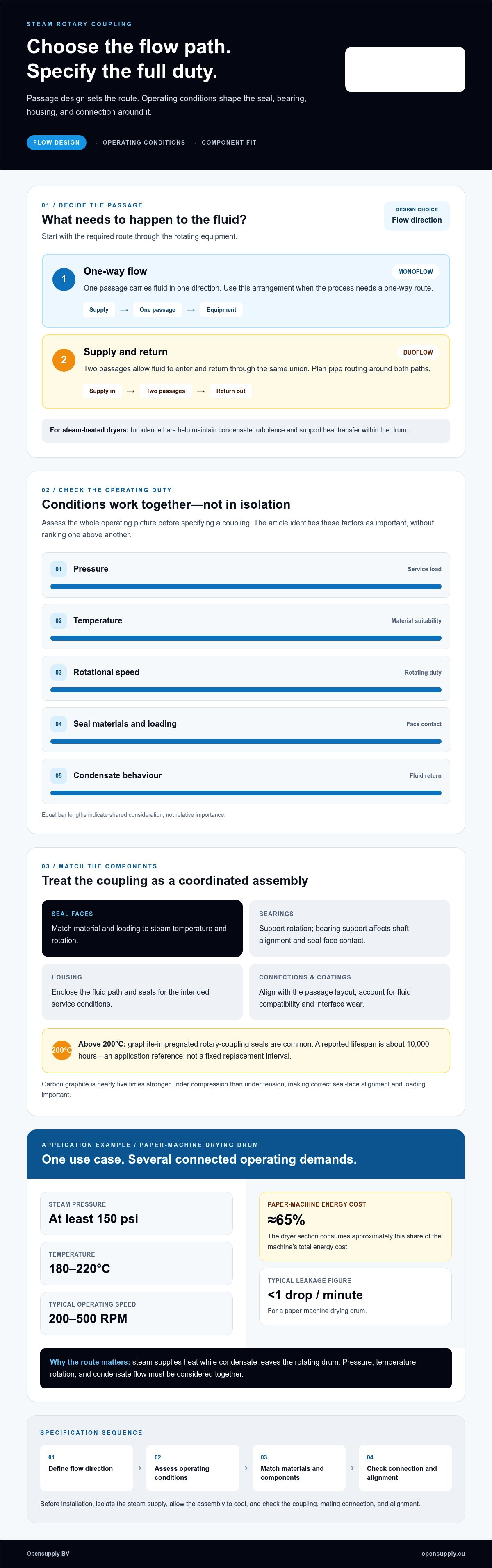
Seal selection starts with the steam temperature, pressure, rotation, and condensate conditions. Above 200°C, graphite-impregnated rotary-coupling seals are common, with a reported lifespan of about 10,000 hours. Treat that figure as an application reference, not a fixed replacement interval. Operating conditions and seal-face loading affect wear. Carbon graphite is nearly five times stronger under compression than under tension, so correct face alignment and loading matter to its performance.
Bearings support the rotating assembly, while the housing encloses the fluid path and seals. These components must suit the application as a system: bearing support affects shaft alignment, which in turn affects contact between the sealing faces. A drying drum handling steam and condensate, for example, has different requirements from a process carrying another fluid. Material and coating choices should account for fluid compatibility, operating temperature, pressure, and wear at the interfaces. A coating cannot make up for a seal material or connection that is unsuitable for the process conditions.
For safe installation, isolate the steam supply, allow the assembly to cool, and check the coupling, mating connection, and alignment before operation. Connect the stationary and rotating sides according to the coupling design, then confirm that the seal, bearing, and housing are suitable for the stated service conditions.
The passage design determines how process fluid enters and leaves. A monoflow rotary union has one passage and carries flow in one direction. A duoflow design has two passages, allowing fluid to enter and return through the same union. This affects pipe routing and the equipment’s fluid circuit, so identify the required flow path before selecting a connection. In steam-heated dryers, turbulence bars help maintain condensate turbulence and support heat transfer within the drum.
- Seal faces: Match material and loading to steam temperature and rotation; graphite-impregnated seals are a common choice above 200°C.
- Connections: Align the fixed supply and rotating equipment with the union’s passage layout.
- Bearings and housing: Select components as a coordinated assembly to support rotation and contain the fluid path.
- Coatings: Consider fluid compatibility and wear at contact surfaces rather than treating a coating as a substitute for correct material selection.
Specify a steam rotary coupling for its full operating duty, not just its seal material. Temperature, pressure, flow direction, condensate behaviour, and rotation all influence the design. A one-way steam supply, for example, calls for a different passage arrangement from a circuit requiring both supply and return. Matching these requirements to the seal, bearing, housing, and connection helps control leakage and maintain the intended fluid path.
Industrial applications in manufacturing, power generation, paper, and textiles
Steam rotary joints serve processes that transfer heat or fluid across a rotating interface. Manufacturing applications include heating and moulding, while power-generation equipment uses steam in thermal processes. Paper and textile operations use steam for drying and heating. In every case, the rotating component and process duty determine the union’s role. A drying drum, for example, needs a continuous steam path as it turns.
Paper machines place demanding requirements on the rotary connection. A coupling can transfer steam at pressures of at least 150 psi and temperatures of 180-220°C to a rotating drying drum. Typical operating speed for this application is 200-500 RPM. The dryer section consumes approximately 65% of a paper machine’s total energy cost, so steam delivery and condensate removal affect a major part of the process. A typical leakage figure for a paper-machine drying drum is less than 1 drop per minute.
The paper-machine example also shows why application figures need context. Pressure, temperature, rotation, and condensate flow work together, rather than serving as separate selection criteria. In a drying drum, steam supplies heat while condensate leaves the rotating equipment, so the union must accommodate both as the drum turns. Paper production differs from moulding, where steam heats material during shaping. The process purpose determines the required fluid route and operating conditions.
Textile production also uses steam for heating and drying. A rotary connection can serve equipment in which a heated roller or other rotating component contacts material during processing. In manufacturing, steam heating may support moulding or another controlled thermal operation. Power-generation applications use rotary unions in steam-handling equipment, where the connection must sustain fluid transfer during rotation. Across these settings, the fluid, equipment motion, and heat-transfer task define the duty.
- Paper: Assess steam supply and condensate return for the drying drum, alongside pressure, temperature, and speed.
- Textiles: Consider whether steam heats or dries material as it moves through rotating equipment.
- Molding: Match the fluid path to the heating stage and the rotating component’s function.
- Power generation: Specify the connection around the steam-handling equipment and its rotational duty.
These applications show why one specification does not fit every plant. A paper dryer’s operating figures describe that use case, not a universal design target. For broader process-line context, review processing-industry equipment alongside the thermal requirements of the application.
How does the union design prevent leakage in high-pressure steam environments?
Leak control starts with matching the coupling to the process duty. Pressure, steam temperature, rotational speed, and condensate behavior all affect seal loading. A mechanical-face-seal design can have a leakage rate below 0.05 cm³/hr. That figure describes a design performance value, not a universal limit for every installation. The sealing faces, bearing support, and housing must function together under operating conditions.
Applicable safety standards and regulations depend on the installation’s jurisdiction and pressure-system requirements. The coupling’s pressure and temperature ratings must suit the system design, and installation must follow the relevant pressure-equipment and workplace-safety rules.
Pressure and temperature ratings are specific to the coupling design. According to DSTI, standard steam rotary joints typically operate at pressures up to 150-300 PSI. DSTI also states that most steam rotary unions can endure temperatures of 350°F-400°F. These are typical ranges, not interchangeable ratings for every series. A separate high-temperature steam coupling type is listed with operating ranges of 150-220 °C and 100-200 PSI.
Speed affects the seal interface, so it belongs in the same selection review as pressure and temperature. For example, a paper-machine drying-drum application may operate at 200-500 RPM. That speed is an application reference, not a rating for all couplings. Fluid matters too: steam and condensate impose different conditions from other process media. Specify the actual fluid path, including whether the assembly requires supply only or supply and return.
Use series-specific data to guide selection. Compare the intended operating conditions with the stated limits for the exact coupling type. Do not assume that a pressure rating for one series also applies to another. Assess these design variables together:
- Fluid: Identify steam service and account for condensate in the return path.
- Pressure and temperature: Match both values to the selected coupling’s operating range.
- Speed: Include the equipment’s rotational duty, such as a drying drum running at 200-500 RPM.
- Sealing arrangement: Consider face loading, alignment, and bearing support as parts of one assembly.
In high-pressure service, a stronger seal alone will not resolve every potential leakage path. Misalignment can disrupt contact between the sealing faces, while an unsuitable passage arrangement can complicate steam supply or condensate return. A practical specification records the process fluid, pressure, temperature, speed, and required flow direction before a series is selected. Engineers can then compare documented ratings with the actual duty instead of relying on a general category label.
How steam rotary joints transfer fluid between stationary and rotating parts
A rotary joint connects a fixed steam line to moving equipment. The stationary side joins the supply pipe; the rotating side connects to a drum, roller, or other machine component. Internal passages carry fluid across the interface as the equipment turns. Seals separate the flow path from the surrounding area, and bearings support rotation. This arrangement lets a paper-machine drying drum receive steam without twisting its supply connection.
The flow path depends on the union design. In a monoflow arrangement, one passage carries fluid in one direction. Steam can enter the rotating equipment through that passage, while condensate leaves through a separate route in the machine. A duoflow rotary union has two passages, allowing fluid to flow into and out of the equipment through the union. The right choice depends on the process circuit and equipment layout.
Consider a steam-heated drum. Steam travels from the fixed pipe through the union and into the rotating drum. Heat passes through the drum wall to the material being processed. As the steam loses heat, condensate forms; the system must carry it away without disrupting steam delivery. The rotary connection provides a path across the rotating interface, while the machine’s internal arrangement governs fluid distribution and drainage.
Sealing components separate the pressurised passage from the outside environment. The seal faces remain in contact as the joint rotates, limiting leakage at the interface. Bearings guide the rotating assembly and help maintain the alignment required for consistent face contact. A robust housing contains the components and supports the fluid route. These elements work together as a unit.
Flow direction is a key specification. A one-way supply can use a single passage, while a circuit requiring both delivery and return can use two. A drying drum with an internal condensate return, for example, may need a different arrangement from equipment that returns condensate through separate piping. The design must match the actual circuit, not just the steam inlet connection.
- Fixed connection: Carries steam from the stationary supply into the union.
- Rotating connection: Delivers fluid to the moving drum or roller.
- Passages: Route supply and, where designed, return flow across the interface.
- Seals and bearings: Contain fluid and support controlled rotation.
During operation, steam enters through the stationary side and crosses the rotary interface into the equipment. In a two-passage arrangement, the return stream crosses back through its own passage. This separates supply and return flow within one connection. For any process, trace the fluid route from inlet to outlet, including where condensate forms and exits. Mapping the flow clarifies which union arrangement suits the equipment.
What is a steam rotary coupling and how does it work?
A rotary coupling transfers steam from a fixed pipe into a rotating machine component. Its stationary connection joins the supply line, while its rotating connection turns with equipment such as a heated roller. The coupling bridges the fixed and moving parts, allowing the machine to rotate without winding the steam line around its shaft.
Inside the assembly, the housing contains the fluid route and supports the sealing components. Bearings guide rotation between the stationary and rotating elements. Seals separate the steam passage from the external environment and limit leakage at the moving interface. Each component has a distinct role: the passage conveys steam, the bearings support motion, and the seals maintain separation.
Consider a steam-heated roller in a production line. Steam enters through the stationary inlet and passes into the roller as it rotates. Heat moves from the steam through the roller surface to the material being processed. As the steam cools, condensate forms inside the equipment. The steam rotary coupling provides the connection, while the machine’s internal drainage route carries condensate away.
The coupling does not generate steam or control the entire heating process. It provides the rotating connection within a larger system that includes the supply pipe, machine component, and condensate route. This distinction matters when designing equipment. A roller that receives steam but returns condensate through separate piping, for example, needs a different connection arrangement from equipment that routes both streams through the joint.
To understand a proposed installation, trace the fluid path through these interfaces:
- Supply line: The fixed pipe delivers steam to the stationary side of the joint.
- Rotary interface: Internal passages transfer steam while the connected machine part turns.
- Equipment: A drum or roller uses the steam’s heat for its process duty.
- Condensate route: The machine circuit directs condensed steam away from the heated component.
Mapping the flow also helps distinguish a rotary joint from a shaft coupling. A shaft coupling connects rotating shafts to transmit mechanical motion; a rotary joint transfers fluid between stationary and rotating equipment. In a steam-heated drum, the two components may work near each other, but they perform different functions. Identifying each interface prevents confusion during specification and layout.
For a process requiring fluid transfer across rotating equipment, compare the steam rotary coupling with the machine’s inlet, rotation, and condensate arrangement. Explore rotary coupling options for industrial equipment applications.
Opensupply: Air shaft
Opensupply BV supplies rotary couplings for processing-industry equipment that transfers fluid across a rotating connection. For applications involving fluid transfer and roll handling, its air shafts and guiding rollers serve related equipment needs. Rigid couplings KTS / KTE / KTA divided two-piece are another option where a shaft connection is required. These components perform different functions, so select them according to the machine interface and operating task.
For a rotary-coupling application, define the fluid, pressure, temperature, speed, and passage arrangement. This information helps narrow the component choice and tie it to the equipment’s duty. A roller pressure indicator complete set may also be relevant when roll-pressure measurement is part of the process.
Contact Opensupply BV to discuss your equipment requirements, or visit opensupply.eu.
Turn operating requirements into a clear specification
The next step is to turn the machine’s operating conditions into a component specification. Record the process fluid, required flow path, equipment interface, and operating duty together. This gives the selection discussion a practical starting point and helps distinguish fluid-transfer requirements from mechanical shaft-connection needs.
Opensupply BV supplies rotary couplings for fluid transfer, rigid couplings KTS / KTE / KTA divided two-piece for shaft connections, and air shafts for roll-handling applications. These components perform different functions, so let the application guide your choice. Specify a steam rotary coupling when steam must pass between stationary piping and rotating equipment.
Share the equipment context and the role of the connection with Opensupply BV. A focused discussion can help match the component category to the process task. Contact Opensupply BV about your application and take the next step toward a suitable specification.
Frequently Asked Questions
What is a Rotary Coupling?
A rotary coupling transfers fluid between a stationary supply and rotating equipment. It differs from a shaft coupling, which connects rotating shafts to transmit mechanical motion. A heated roller, for example, may need one component for its steam circuit and another for its drive. Identifying whether the requirement is fluid transfer or torque transmission helps prevent the wrong component being specified at a machine interface.
What is a steam rotary joint?
A steam rotary joint carries steam from fixed piping into rotating machinery. “Rotary union” is another term for this type of fluid-transfer component. In a heated drum, the joint connects the steam circuit while the drum turns. Its passage arrangement must match the machine’s supply and condensate-return layout, including whether both streams use the same connection.
What types of rotary couplings are available for steam service?
Common passage arrangements include monoflow and duoflow designs. Monoflow uses one passage for flow in one direction; duoflow has two passages for fluid entering and leaving through the union. Seal configurations also vary, including mechanical-face-seal designs. Choose the passage type to suit the process circuit. For example, determine whether condensate returns through the joint or through separate piping.
How do I select a coupling by pressure, temperature, speed, and flow rate?
Start with the process fluid, operating pressure, and temperature, then include rotational speed and required flow direction. Record whether the connection carries supply only or supply and return. A paper-machine drum, for example, may operate at 200-500 RPM, but that figure describes an application, not a universal rating. Compare the full operating duty with the selected coupling’s specifications.
What materials and seal types are used in steam service?
Seal materials depend on temperature and operating conditions. Graphite-impregnated seals are common for steam above 200°C, with a lifespan of about 10,000 hours as an application reference. Mechanical-face seals are another design. For a steam rotary coupling, material choice should account for seal-face loading and the operating environment. Carbon graphite is nearly five times stronger under compression than under tension.
How can I maintain a coupling and troubleshoot leaks?
Inspect the assembly every 500 operating hours for leakage, unusual noise, and elevated temperature. Include seal wear and lubrication in routine checks. An external temperature reading more than 10°C above the normal application temperature is a warning sign. If a steam rotary coupling leaks, note when it occurs and whether noise or temperature also changes. These observations help identify conditions affecting the seal or alignment.
What pressure and temperature limits apply?
Limits vary by coupling design, so assess pressure and temperature as a matched rating. According to DSTI, standard steam rotary joints typically operate at pressures up to 150-300 PSI, and most steam rotary unions can endure 350°F-400°F. A separate high-temperature coupling type is listed for 150-220 °C and 100-200 PSI. These are distinct specifications, not one combined operating range.
How much does a steam rotary coupling cost?
A basic rotary-coupling seal kit typically costs $150−$400 through suppliers like Opensupply BV.


