

A rotary union’s seals do more than prevent leaks: they help keep separate flow paths isolated as equipment turns. A water rotary coupling transfers water from a stationary supply to a rotating machine component. Its ports connect the supply and outlet, its internal channels carry the water, and its seals manage the interface between stationary and rotating parts.
The arrangement can seem straightforward until a design must handle multiple media, keep channels separate, or control leakage at the rotating interface. Port layout, channel configuration, and seal design all affect how the coupling performs in service.
This guide explains how water rotary couplings work and the roles of their ports, channels, and seals. It also covers how rotary unions transfer media between stationary and rotating components, why seal arrangement matters for leak prevention, and which operating conditions influence selection. The aim is to clarify the assembly and its role in an industrial system.
Key Takeaways
- Match the coupling configuration to the water application, including the required flow path and connection layout.
- Understand how the stationary inlet, rotating component, and internal passages work together to transfer media.
- Consider the housing, shaft, bearing, and seal arrangement when assessing a coupling for cooling or temperature-control duties.
- Use port and channel layout to keep separate media paths distinct and support the machine’s flow requirements.
- For roll-handling equipment, Opensupply BV’s air shaft is a relevant offering to consider alongside the coupling assembly.
What is a Water Rotary Union?
A rotary union transfers water between a stationary supply line and rotating equipment. Its ports connect the lines, while internal passages and seals manage flow across the rotating interface.
Custom Configurations for Water Applications
A custom configuration adapts the port layout, number of passages, and sealing arrangement to the water circuit and machine interface. This matters when equipment requires separate flow paths or a specific inlet and outlet orientation. For example, a two-passage union can carry liquids or gases through independent channels. Choose a configuration to match the required flow paths and connections, not just the machine’s mounting space.
Available Coupling Types and Costs
Water rotary couplings come in configurations that differ by passage count, port arrangement, and application. A single flow path serves one circuit; multiple independent passages can carry separate media. There is no single price for every design in the United States. Cost depends on the configuration, sealing arrangement, materials, and operating conditions, so the application specification determines the suitable design and its cost.
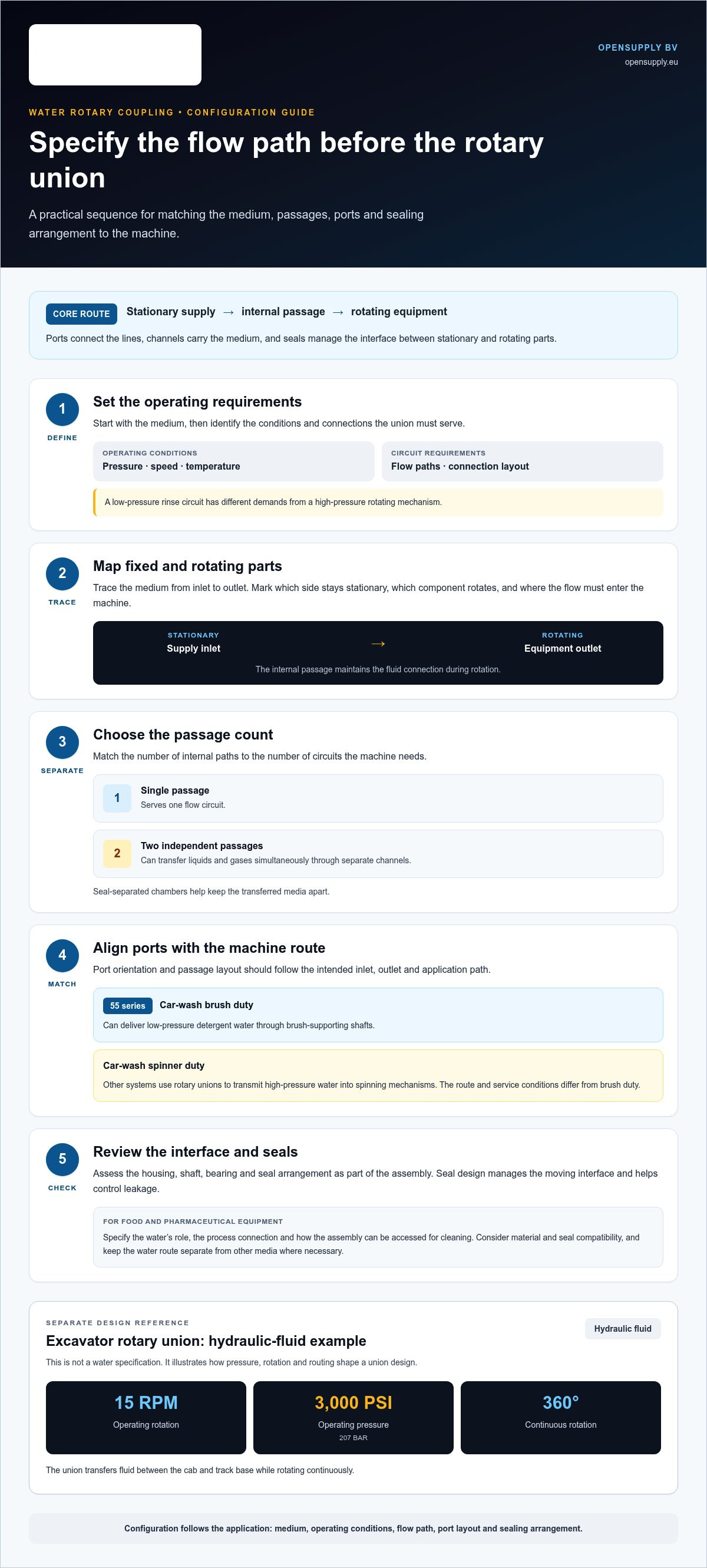
Define the machine’s operating requirements before comparing rotary union configurations. Start with the medium, then identify the pressure, speed, temperature, required flow paths, and connection layout. These factors influence passage design and seal selection. A water rotary coupling for a low-pressure rinse circuit has different demands from one serving a high-pressure rotating mechanism. Keep the machine interface and intended duty in view.
Car-wash equipment shows why application details matter. A 55 series rotary union can deliver low-pressure detergent water through brush-supporting shafts. Other automatic car-wash systems use rotary unions to transmit high-pressure water into spinning mechanisms. Brush and spinner duties therefore differ in both delivery path and service conditions. Identify whether the union feeds a brush shaft or a spinning mechanism, then match the ports and passages to that route.
Food and pharmaceutical equipment requires close attention to the water path and cleaning needs. The union must fit the process connection and keep its flow route separate from other media where necessary. Specify the water’s role, the equipment interface, and how the assembly can be accessed for cleaning. These details guide material and seal compatibility decisions without assuming every process has the same hygiene or operating requirements.
Hydraulic excavators provide a useful comparison, although the transferred medium is hydraulic fluid, not water. An excavator rotary union transfers fluid between the cab and track base while rotating at 15 RPM and operating at 3,000 PSI (207 BAR). It rotates continuously through 360 degrees. This example shows how rotary unions maintain a fluid connection across moving machine sections, with pressure, rotation, and routing shaping the design.
How rotary unions transfer media between stationary and rotating parts
A rotary union carries media across an interface where one side remains fixed and the other turns. The stationary inlet feeds an internal passage, which directs the medium through the rotating assembly to its outlet. In a water rotary coupling, this route maintains water delivery as the connected equipment rotates. The housing, shaft, bearing, and seals support the transfer and manage movement at the interface.
The flow path depends on the union’s passage layout. A single passage serves one circuit, while a two-passage union can transfer liquids and gases simultaneously through independent channels. Seal-separated chambers keep the transferred media apart. This separation matters when a machine needs water for cooling and another medium for a separate function. Connect each port to its intended circuit.
Rotation does not require a hose connection that changes with every turn. The union maintains communication between the stationary supply and rotating equipment as the rotating side moves. This arrangement suits applications that need a continuous fluid path during rotation. For example, a rotating table can receive water through a fixed supply line, with the union routing it into the moving assembly. The channel and outlet positions determine how water reaches the machine.
Continuous casting is one industrial example of water transfer to rotating equipment. Cooling water can pass from fixed pipework through a rotary union into a rotating roll or another process component. When the design uses separate circuits, the union’s passages keep the supply and return routes distinct. This delivers water to moving equipment without twisting a stationary connection around the rotating part. The required flow route, port position, and media separation shape the configuration.
Selection starts with tracing the media route from inlet to outlet. Identify which components rotate, which remain stationary, and whether the assembly carries one medium or several. Then align the port arrangement and passage count with those connections. Pressure, speed, temperature, and seal design also affect how the union handles the application. For equipment that also needs a rotary connection, review rotary coupling options as part of the assembly specification.
Rotary unions in industrial cooling and temperature control
Rotary unions maintain media flow into or out of rotating process equipment. Cooling performance depends on the flow path, operating conditions, and component arrangement.
Cooling and Temperature Control Uses
In industrial cooling, a rotary union routes water or another heat-transfer medium to rotating equipment. This supports temperature control without winding a stationary supply line around the moving component. The required flow path depends on whether the system supplies, returns, or separates media. For example, cooling rolls need a union arrangement that connects the process circuit to the roll.
Paper and textile production use rotating rolls where temperature can affect processing. A union transfers the selected medium through the roll as it turns. In paper production, the roll’s cooling or heating circuit and connection layout guide the union configuration. Textile machinery also depends on matching the rotating component’s media path to the process requirements.
Media Handled by Rotary Unions
Rotary unions can transfer liquids, solids, and gases between stationary inputs and rotating parts. Water may serve a cooling circuit, while air or steam can suit other process functions. The medium affects channel design and seal selection because each path must contain its intended flow. Identify every medium and its destination before choosing a union with one or multiple passages.
Separate passages help prevent different media from mixing. A two-passage union can transfer liquids and gases simultaneously through independent channels. This is useful when a rotating assembly needs more than one service connection. For example, a machine may require water in one circuit and air in another, with seal-separated chambers keeping the routes distinct.
Housing, Shaft, Bearings, and Seals
A rotary union has four basic components: a housing, shaft, bearing, and seal. The housing supports the assembly, while the shaft provides the rotating interface. Bearings guide movement, and seals control leakage between stationary and rotating areas. A union may use one bearing, but multiple bearings are more common. Each component must suit the required rotation and media path.
Some larger flanged designs reverse this arrangement: the housing rotates while the shaft stays stationary. This affects how the union connects to the machine and fixed pipework. Confirm which part turns when mapping the assembly. That determines how the inlet, outlet, and mounting interface relate to the surrounding equipment.
Materials and Operating Ratings
Material selection depends on the medium, pressure, temperature, and process exposure. These factors also shape seal and passage choices. Rotary union applications typically operate at pressures from 0 to 20,000 PSI (1,380 BAR), while some applications exceed 40,000 PSI (2,760 BAR). These broad ranges describe varied applications, not a single water-service rating.
Temperature conditions also vary by duty. Rotary union applications typically have environmental and media temperatures from -150°F to +400°F (-100°C to 200°C). High-speed applications can exceed 10,000 RPM, so speed must be considered alongside pressure and temperature. Compare the operating conditions as a set, rather than using one rating to represent the whole assembly.
Port and channel configurations
Install a rotary union by aligning its mounting interface, then connecting each port to the matching supply or return line. Trace every passage from inlet to outlet before connecting the machine to keep separate channels correctly routed.
Ports are the external connection points; channels are the internal routes that carry media through the union. Their arrangement determines how fixed pipework connects to rotating equipment. A single-channel design serves one flow path. A two-passage union can carry separate media through independent channels, with seal-separated chambers keeping them apart.
Start with a simple connection map. Mark the stationary supply, union inlet, rotating outlet, and any return line. For a cooling circuit, identify where water enters the union and where it exits into the rotating component. If the assembly has separate supply and return paths, map both channels independently instead of treating the housing as one open passage.
- Identify each port. Match the union’s inlet and outlet connections to the machine’s fixed and rotating sides. Use the port markings and the equipment drawing to distinguish supply from return.
- Align the mounting interface. Seat the union squarely against its mounting face. The shaft and connected equipment must follow their intended alignment to avoid placing unwanted loads on the connection.
- Connect each line to its route. Attach the stationary supply to the inlet and route the outlet to the rotating component. For a two-passage design, connect each circuit to its own corresponding ports.
- Review the flow path. Trace the route again from each supply through the union to its destination. Confirm that separate media paths remain separate and that hoses or pipes do not obstruct rotation.
Port orientation matters as much as passage count. A side connection may suit a different machine layout than an axial connection, while an offset line can interfere with nearby components. For example, a compact rotating assembly may need ports positioned to clear its frame. Choose an arrangement that matches the equipment connections and leaves the rotating section free to move.
Rotation also affects how the union connects. In an excavator example, the rotary union transfers hydraulic fluid through continuous 360-degree rotation between the cab and track base. The same principle applies to water transfer, though the port route and media requirements differ. Check which union component rotates, then connect the stationary lines and rotating equipment accordingly.
Correct routing supports the intended flow and keeps distinct channels isolated. A rotary coupling selected for a machine should match its port layout, passage arrangement, and connection direction. These details make it easier to integrate the assembly with existing pipework and rotating equipment.
Mechanical seals and leak prevention
Seals control leakage where a rotary union connects stationary pipework to rotating equipment. They must maintain separation while the parts move relative to each other. Most rotary unions have more than one seal, with each serving a position in the assembly. This arrangement helps contain the medium and separate channels carrying different fluids.
Preventing leaks starts with matching the seal design to the operating conditions. Pressure loads the sealing interface, while rotational speed affects movement and friction. Temperature and the transferred medium also matter because they influence material compatibility. A water rotary coupling for a cooling circuit faces different conditions from a union carrying steam or hydraulic fluid. Define the actual duty before selecting sealing materials.
Seal placement determines which areas the union protects. A seal between two passages helps keep their media apart. A seal at the rotating interface limits leakage along the shaft or housing. For example, a two-channel assembly carrying water and air needs separation between those routes as well as containment around the rotating connection. The seal arrangement must match both the flow path and the interface.
Use a clear review sequence when specifying a union:
- Identify the medium. Record whether the circuit carries water, air, steam, or another fluid, and note any compatibility requirements.
- Define operating conditions. Include pressure, speed, and temperature because each affects the sealing interface.
- Map the channels. Show where each medium enters and exits, especially when seal-separated passages prevent mixing.
- Review the installation interface. Confirm that mounting and alignment support the intended contact between stationary and rotating parts.
During operation, the location of a leak can help narrow down its cause. Fluid near a port may point to a connection issue, while leakage at the rotating interface directs attention to the seal arrangement or operating conditions. These are diagnostic clues, not a substitute for evaluating the assembly. A change in medium, pressure, speed, or temperature can alter the demands on the seals.
Mechanical seals are relevant when a design needs a controlled sealing interface around moving components. Sleeveless seals are another distinct category, but suitability depends on the application and union design. Avoid selecting by seal name alone. The medium, channel layout, operating conditions, and assembly interface together determine the sealing approach required.
For a rotary union specification, map the flow paths and operating conditions before finalizing the seal arrangement. Review sealing requirements alongside the assembly details.
Opensupply: Air shaft
Opensupply BV supplies air shafts and rotary couplings for processing equipment where roll handling or rotary fluid transfer is part of the system. An air shaft supports roll handling, while a rotary coupling transfers media between stationary and rotating components. These components serve different functions, so choose according to the machine’s requirements.
For connected drive assemblies, Opensupply BV also supplies Rigid couplings KTS / KTE / KTA divided two-piece. A roller pressure indicator complete set supports roll-pressure measurement. These products may be relevant when specifying components around a rotary union.
Contact Opensupply BV to discuss the component that fits your equipment application.
Turn the Selection into a Clear Specification
Make the next step a concise application specification. Record the medium, connection layout, operating conditions, and required separation between flow paths. This gives engineering and purchasing teams a shared basis for comparing designs and assessing how a water rotary coupling fits the machine.
Consider adjacent components in the same equipment assembly. Opensupply BV supplies rotary couplings, air shafts, and Rigid couplings KTS / KTE / KTA divided two-piece. These categories serve different functions but may be relevant when a project involves both rotary media transfer and shaft or roll handling.
Bring the application requirements together before selecting components. Contact Opensupply BV to discuss your needs and identify a practical next step for your equipment specification.
Frequently Asked Questions
What is a rotary coupling for water and how does it work?
A water rotary coupling transfers water from fixed pipework into a rotating machine component. For example, a rotating wash brush can receive water through a stationary supply without the hose turning with it. The coupling’s internal passage directs water across the rotating interface. Port arrangement and seals route the flow to its intended connection while the equipment operates.
How do I choose a rotary coupling for my application?
Match the coupling to the machine’s operating conditions and interfaces. Document the medium, pressure, temperature, rotational speed, required flow, and connection layout. Then determine whether the assembly needs one water circuit or separate passages. For a wash system, distinguish a brush feed from a spinner feed. The configuration should suit the duty and mounting arrangement, not simply the available space.
What flow rates and speeds are typical?
Flow rate depends on passage size, internal restrictions, supply pressure, and machine demand. Rotary unions typically operate from 0 to 1,000 RPM; some high-speed applications exceed 10,000 RPM. These figures describe varied application ranges, not a universal operating specification. Assess flow and rotation together. For example, a high-demand cooling circuit needs a suitable flow path as well as a union designed for its rotational conditions.
How can I maintain the coupling and troubleshoot leaks?
First identify where water appears: at a pipe connection, housing joint, or rotating interface. Inspect connected lines and fittings for looseness or visible damage. Record the pressure, temperature, and speed when leakage occurs, then compare those conditions with the assembly requirements. Follow the equipment manufacturer’s inspection guidance. The leak location can help narrow down the cause, but the full connection and operating conditions matter.
What can cause failure, and how long will the coupling last?
Potential failure risks include seal wear, incompatible media, misalignment, contamination, and operation beyond design conditions. Their effects depend on the application. Contamination can damage sealing surfaces, while misalignment can add load at the rotating interface. Service life depends on operating cycles, speed, pressure, temperature, water quality, and maintenance conditions. Review these factors together when assessing performance or planning replacement.
How does this component compare with a rotary union or swivel joint?
The terms water rotary coupling and rotary union often describe components that transfer fluid across a rotating connection. A swivel joint also provides a rotating connection, though its design and intended duty can vary. The terminology alone does not define passage count, pressure capacity, speed, or media compatibility. Compare connection layout and operating requirements, then select by function and specification rather than name alone.


